
A custom low-temperature lithium battery pack must do more than survive cold storage. It must deliver usable energy without excessive voltage sag, support the equipment’s peak load after a cold soak, and prevent unsafe charging when the cells are below their approved charging temperature. These requirements are different for every device, which is why a cold-weather battery should be designed around the actual temperature profile, load data, charging source and installation conditions.
We develop low-temperature Li-ion and LiFePO4 battery packs for outdoor instruments, marine electronics, remote monitoring equipment, robotics and other OEM devices. Cell selection, capacity, BMS thresholds, heating, insulation, enclosure and validation are coordinated as one system. A temperature claim such as “works at -40°C” is not treated as a complete specification until the discharge load, cold-soak time, charging method and test acceptance criteria are also defined.
How Cold Weather Changes Lithium Battery Performance
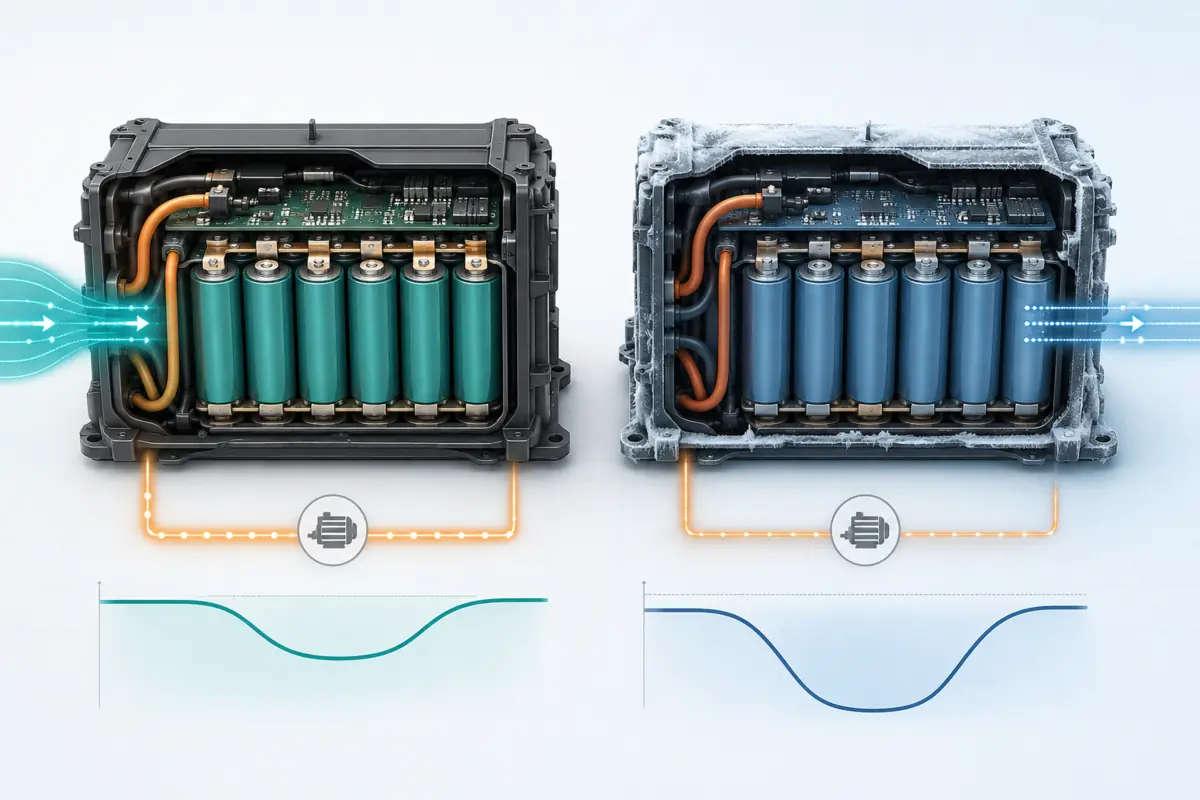
Cold weather does not affect every lithium battery at the same rate. Results depend on cell chemistry, electrolyte formulation, state of charge, discharge current, cell age and how long the pack remains at the minimum temperature. Four effects are especially important during pack design:
- Higher internal resistance: The pack experiences more voltage drop under load, particularly during startup or other peak-current events.
- Lower usable energy: A battery that delivers the required runtime at room temperature may reach the device’s low-voltage cutoff earlier in the cold.
- Reduced power capability: Continuous and pulse-current limits may need to be derated at the minimum operating temperature.
- Stricter charging limits: Charging a conventional lithium cell below its approved temperature can cause lithium plating, capacity loss and an increased safety risk.
This is why a cold-weather lithium battery cannot be specified by nominal voltage and amp-hours alone. The minimum loaded voltage, required runtime and charge strategy must all be checked at the actual cell temperature.
Define the Temperature Conditions Before Selecting Cells
“Operating temperature” is often too broad to guide an engineering decision. A useful specification separates discharge, charging, storage and cold-soak conditions.
| Temperature condition | What the buyer should provide | Why it changes the design |
|---|---|---|
| Minimum discharge temperature | Lowest ambient temperature, continuous and peak current, and required runtime | Determines cell selection, cold-current capability, capacity margin and device cutoff compatibility |
| Minimum charging temperature | Lowest temperature at which charging may begin and whether external power is available | Determines charge lockout, reduced-current rules and whether preheating is needed |
| Storage temperature | Minimum and maximum storage temperature, storage duration and expected state of charge | Must be checked separately from active discharge and charging limits |
| Cold-soak duration | How long the unpowered equipment may remain in the cold before startup | Distinguishes a brief exposure from a pack whose cell core has fully reached ambient temperature |
| Warm-up requirement | Maximum acceptable time from power connection to normal operation or charging | Sets heater power, insulation and energy-reserve requirements |
Two Common Cold-Weather Battery Architectures
1. Low-Temperature Discharge Pack
This design uses cells selected for sub-zero discharge performance and a BMS configured for the approved temperature window. It is suitable when the equipment must start and operate in the cold but can be charged after returning to a warmer environment. The BMS blocks charging below the cell manufacturer’s approved threshold and releases charging only after the pack temperature recovers.
2. Self-Heated Battery Pack
A self-heated pack uses a flexible heating film, PTC heater or another controlled heating element to warm the cells before charging or high-power operation. Heater start and stop temperatures, sensor locations, available input power and warm-up time must be defined during design. Heating can be powered from the charger, an external supply or the battery itself, but each method changes the wiring, BMS logic and usable runtime.
Insulation and heating perform different jobs. Insulation slows heat loss; it does not generate heat. A heater raises the cell temperature but consumes energy and requires a safe control strategy. Some applications need both.
Cell Chemistry and Pack Configuration
Cell selection begins with validated data at the required temperature and load, rather than chemistry name alone. Low-temperature NMC Li-ion cells can be useful for compact equipment that needs higher energy density or strong pulse output. LiFePO4 may be preferred when cycle life and thermal stability are priorities, but its cold-temperature limits still depend on the specific cell model and charging strategy. Standard and low-temperature versions of the same chemistry should not be assumed to perform identically.
Depending on voltage, energy, current and installation space, the pack may use 18650 cells, 21700 cells, prismatic cells or lithium polymer pouch cells. The series-parallel configuration is then checked against:
- Equipment input-voltage range and low-voltage cutoff
- Continuous current, startup current and pulse duration
- Required runtime at the minimum temperature
- Available space, weight limit and mounting direction
- Heater energy, BMS consumption and design reserve
- Target cycle life and charging schedule
Capacity Sizing Must Use Cold-Tested Energy
Room-temperature nameplate capacity is not enough for a lithium-ion battery used in cold weather. The design should use the energy delivered by the selected cell under the project’s minimum temperature and load profile.
Illustrative sizing example:
If a device requires 40Wh during one cold operating cycle and prototype testing shows that the selected configuration delivers 70% of its room-temperature energy under that exact load and temperature, the starting nominal energy is:
40Wh ÷ 0.70 = approximately 57Wh
If a 20W heater runs for 15 minutes using battery energy, it consumes another 5Wh:
20W × 0.25h = 5Wh
Engineering reserve, aging, wiring loss and the device cutoff must still be added. The percentages and values above explain the method only; they are not guaranteed performance figures for every pack.
Low-Temperature BMS and Heating Control
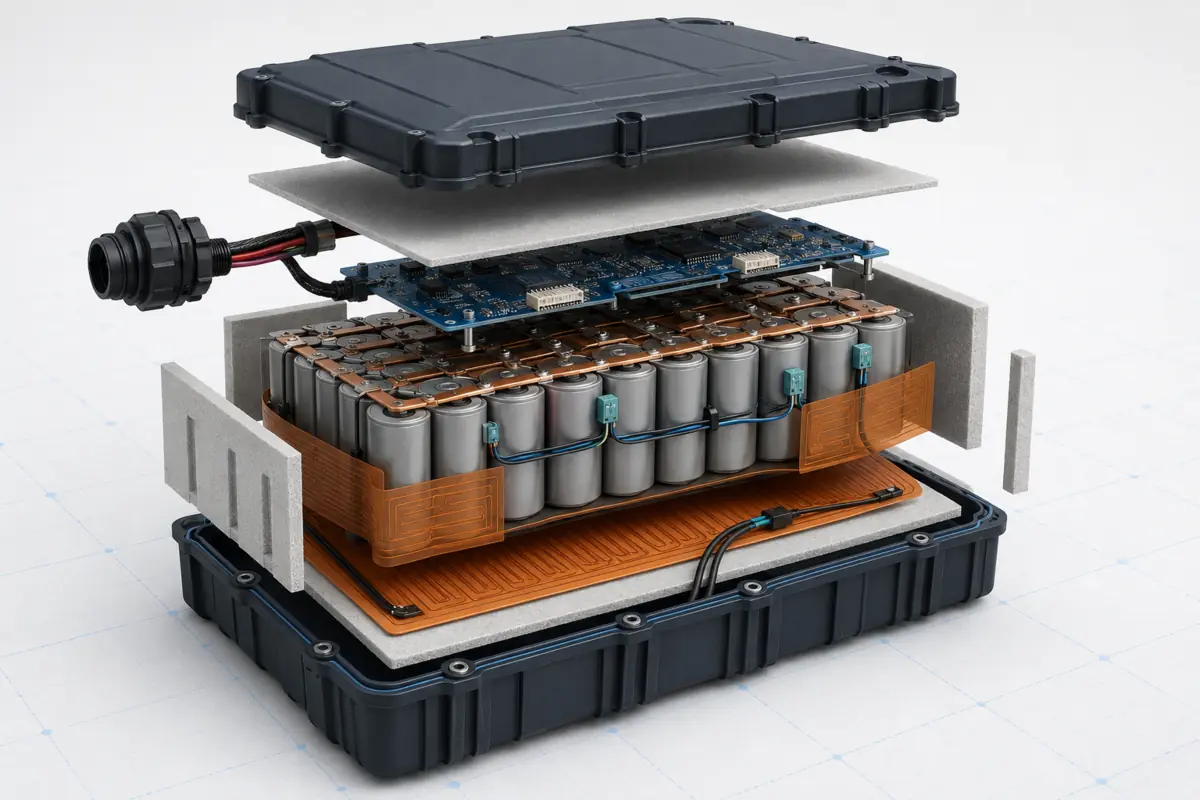
The BMS protects the pack, but it cannot convert an ordinary cell into a low-temperature cell. Cell capability, sensor placement and control thresholds must work together. A project-specific low-temperature BMS may include:
- Multiple temperature sensors positioned near representative cold and warm cell locations
- Low-temperature charge cutoff and a separate recovery temperature
- Temperature-based discharge limits for continuous and peak current
- Heater start, stop and timeout control with suitable hysteresis
- Overvoltage, undervoltage, overcurrent and short-circuit protection
- Cell balancing and state-of-charge estimation appropriate to the application
- Optional CAN, SMBus, RS485 or UART communication
- Fault logging for temperature, heater and protection events
In a typical preheating sequence, the BMS first checks cell temperature, prevents cell charging when the pack is too cold, directs available power to the heater, and enables charging only after the approved recovery temperature is reached. The final sequence and thresholds are set from the selected cell data and verified on the prototype.
Mechanical Design for Cold and Outdoor Use
Cold-environment reliability also depends on pack construction. The enclosure, seals, cables and mounting points must remain functional through temperature changes, condensation and vibration. Available design measures include:
- Thermal insulation selected around the available space and required warm-up time
- Cold-flexible cables, strain relief and application-specific connectors
- Water-resistant or dust-resistant enclosures designed to the project’s target ingress level
- Internal fixation for cells, BMS, sensors and heating elements
- Condensation management and material selection for repeated thermal cycling
- Rugged housings for marine, field, vehicle or industrial equipment
An IP rating, vibration standard or impact requirement should be specified before enclosure tooling or final sealing is confirmed. “Outdoor rated” by itself is not a complete mechanical requirement.
Custom Specification Framework
| Item | Custom options | How it is confirmed |
|---|---|---|
| Voltage and capacity | Matched to device input range, load profile and required runtime | Electrical review and cold-load validation |
| Cell chemistry and format | Low-temperature Li-ion or LiFePO4; cylindrical, prismatic or pouch where suitable | Cell data review followed by prototype testing |
| Discharge temperature | Specified separately from charge and storage temperature | Cold-soak discharge test using the actual or simulated load |
| Charging temperature | Charge lockout, reduced-current strategy or preheating where approved | Charge-interlock and recovery test |
| BMS | Protection, balancing, temperature control, heater control and optional communication | Functional test and fault verification |
| Heating | Flexible film, PTC or project-specific external heating interface | Warm-up time, power consumption and temperature-uniformity test |
| Enclosure | PVC shrink, molded housing or sealed rugged enclosure | Drawing approval and application-specific environmental testing |
| Documentation and compliance | UN 38.3 testing and test summary, SDS/MSDS, and applicable IEC or UL evaluation | Confirmed by destination market, application and final battery configuration |
Prototype and Low-Temperature Validation
Sample testing is necessary because a cell data sheet does not represent every pack layout, connector loss, BMS cutoff or device load. The validation plan is agreed before testing and can include:
- Cold soak: Hold the pack at the target temperature long enough for the cell core and enclosure to stabilize.
- Cold start: Apply the equipment’s actual startup or peak-current profile and record minimum loaded voltage.
- Runtime and energy: Measure delivered amp-hours and watt-hours to the agreed cutoff under the required duty cycle.
- Charge protection: Confirm that charging is blocked below the approved threshold and restored only under the specified conditions.
- Heating performance: Measure warm-up time, heater energy, temperature uniformity and control response.
- Thermal cycling: Check cables, seals, enclosure, insulation and condensation behavior through repeated temperature changes.
- Application tests: Add vibration, shock, ingress or communication checks when required by the final equipment.
A useful test record includes starting cell temperature, ambient temperature, load profile, delivered energy, minimum voltage, heater consumption and every BMS protection event. Acceptance limits should be agreed before pilot production.
Documentation and Certification Planning
Compliance requirements depend on battery configuration, equipment type and destination market. We can plan support for UN 38.3 transport testing and the required test summary, SDS/MSDS documentation and project-specific safety evaluation. IEC 62133-2 may apply to portable sealed lithium battery applications, while IEC 62619 may be relevant to certain industrial batteries. UL requirements must be identified by the final product category and market rather than treated as one universal battery certification.
Certification planning should begin before the final enclosure, BMS and cell configuration are frozen. A later change to the cell, series-parallel layout, BMS or housing may affect the applicable test program.
Best-Fit Applications
Custom low-temperature lithium battery packs are commonly developed for:
- Remote monitoring stations, weather instruments and outdoor IoT gateways
- Marine navigation, offshore electronics and sealed field equipment
- Cold-chain trackers, data loggers and portable inspection devices
- Robots, autonomous inspection platforms and special-purpose vehicles
- Emergency communication, surveying and high-altitude equipment
- Portable OEM devices that remain unpowered outdoors before startup
The same ambient temperature can produce different results in a low-power sensor and a high-current robot. Application, current profile and cold-soak duration therefore remain part of every quotation review.
Information Needed for a Custom Design
For an efficient engineering review, provide as many of the following details as possible:
- Nominal voltage and acceptable device input-voltage range
- Required capacity, runtime or energy per operating cycle
- Continuous current, peak current and pulse duration
- Minimum discharge, charging and storage temperatures
- Cold-soak duration and maximum acceptable warm-up time
- Charging source, charging voltage/current and whether external heater power is available
- Maximum dimensions, weight, connector, cable length and pin definition
- Ingress, vibration, shock, communication and mounting requirements
- Target market, required documents, sample quantity and forecast order volume
Related Custom Battery Support
Review our complete custom battery pack engineering service, compare existing low-temperature battery pack models, learn how samples are checked through our battery quality control process, or send your temperature and load requirements for a project review.
Frequently Asked Questions
Can lithium batteries discharge at low temperature?
Yes, when the selected cells, pack configuration and BMS are suitable for the required temperature and load. Usable energy, voltage and current capability normally decrease in the cold, so performance must be validated at the project’s minimum cell temperature.
Can a lithium battery charge below 0°C?
Most conventional Li-ion and LiFePO4 cells should not be charged below their manufacturer-approved temperature. A custom pack can block charging when the cells are too cold and, where suitable, use controlled preheating or an approved reduced-current strategy before charging begins.
What is the difference between a low-temperature battery and a self-heated battery?
A low-temperature battery uses cells selected to deliver energy and current in the cold. A self-heated battery adds a controlled heater to raise cell temperature before charging or demanding operation. Some projects combine low-temperature cells, insulation and heating.
Can lithium batteries freeze?
Storage survival, discharge capability and charging permission are separate questions. A pack may tolerate a specified cold-storage condition but still be unable to deliver rated power or accept charge at that temperature. The limits must be taken from the selected cell data and confirmed at pack level.
How is capacity selected for a cold-weather lithium battery?
Capacity is calculated from required load energy, cold-temperature energy retention, device cutoff, heater consumption, aging allowance and engineering reserve. Room-temperature amp-hours alone should not be used to predict cold runtime.
Is sample testing necessary?
Yes. The prototype should be cold-soaked and tested with the actual or simulated device load. The test confirms minimum voltage, delivered energy, BMS behavior, charge lockout, heater performance and mechanical suitability before batch production.
What documentation is available?
Depending on the final configuration and market, support can include UN 38.3 transport testing and test summary, SDS/MSDS documentation, and evaluation to applicable standards such as IEC 62133-2 or IEC 62619. UL and other market requirements are reviewed against the final application.